

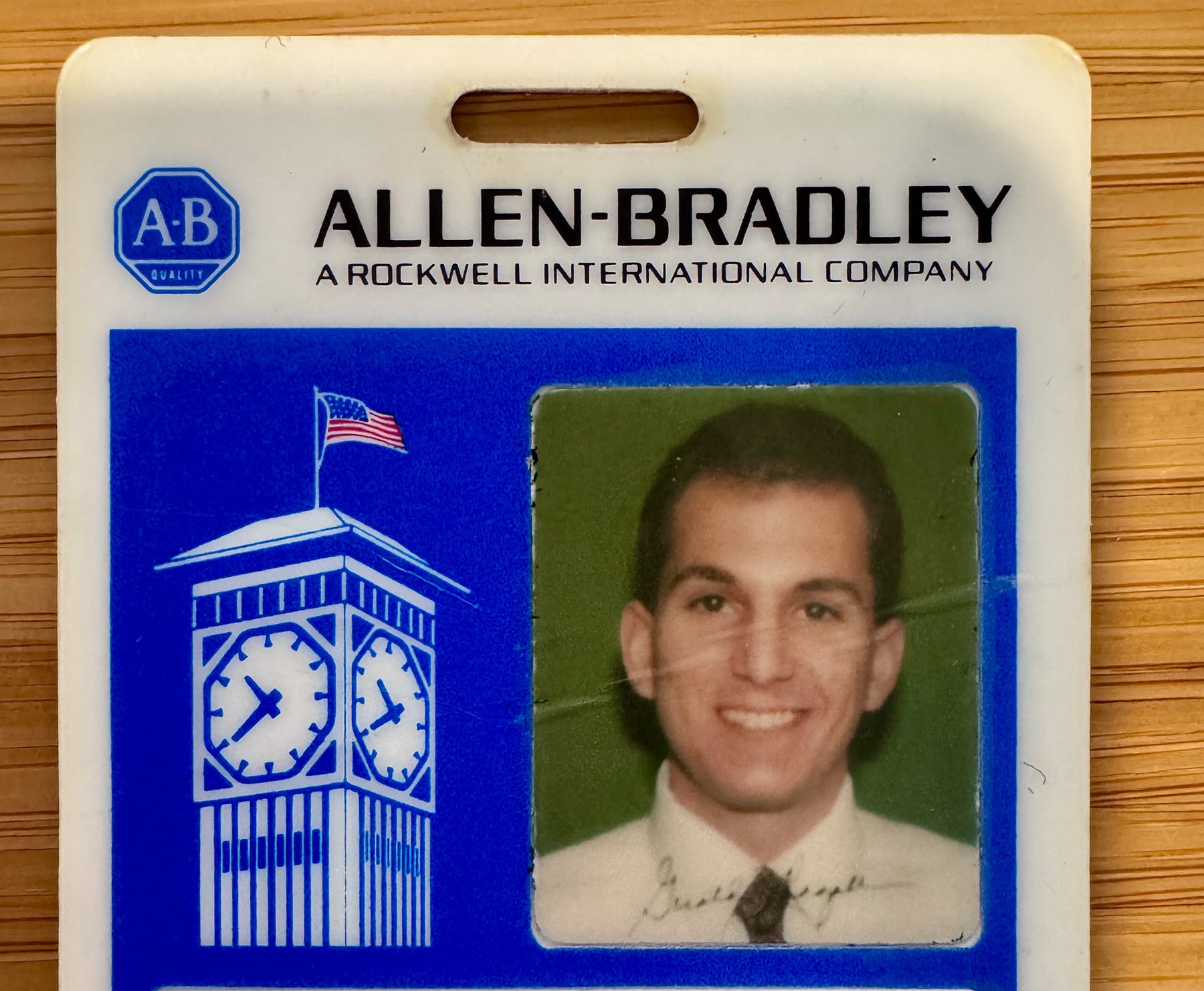
When I started my career at 23, I was like most young professionals — enthusiastic and excited about what lay ahead. I was unspoiled, unaware of bureaucracy, politics, silos, competing interests, and the many realities of any workplace.
I worked in an office adjoining the large factory we supported. Those two co-dependent worlds operated in vastly different realities. The air-conditioned office was where ideas could run unconstrained. The hot factory floor was where the brutal realities of bending steel reminded you otherwise. It was a fantastic place to observe and learn.
After a year or so, my outlook looked very different from the idealistic young man in my ID badge photo. I still loved my job and the company I worked for, but the world I had imagined was far different from what I was experiencing. Frenetic shifts in priorities, conflicting incentives, and the inherent unpredictability of manufacturing brought a crushing realism to a bright-eyed young engineer.
Like many young employees, a touch of cynicism crept in as my worldview shifted. I doubted leadership’s competence. I scoffed at inconsistent messaging. I arrogantly assumed I could do better.
Was I arrogant? Yes.
Was I wrong? Also yes.
It wasn’t until I stepped into leadership roles years later that I began to understand the true weight of the responsibility. Leading a manufacturing organization — or any complex enterprise — is an exceptionally demanding undertaking. Competing incentives rarely disappear. Priorities never fully stabilize. Tradeoffs are constant and visible.
But there was something else I had been wrong about.
I used to make fun of the culture-defining posters that lined the walls. One in particular stood out: Attitude Is Everything. I would joke with friends about how out of touch it seemed with the prevailing sentiment.
At the time, I thought I was right.
I wasn’t.
Attitude really is everything.
It’s one of the few choices fully within our control. It shapes the tone of our meetings, the quality of our decisions, the trust we build, and the culture we either strengthen or erode. Our attitude can be our greatest asset — or our greatest liability — and it is always visible to those we lead.
As my leadership responsibilities grew, I began to understand just how fragile culture is — and how quickly it mirrors the mindset of the person at the top.
I quickly learned how wise counsel appears when your attitude is right — but it took me much longer to notice the silence when my attitude was sour.
I quickly learned that one bad employee can poison an entire team — but it took me longer to act decisively in protecting the broader culture.
I quickly learned how important it is for actions to match words — but it took me longer to recognize my own hypocrisy.
I quickly learned how the people you associate with shape your outlook — but it took me longer to evaluate who was shaping mine.
I quickly learned how a bad day can spiral — but it took me much longer to understand that circumstances only controlled my outlook when I chose to feel like a victim.
Years later, these lessons took on new meaning in an unexpected place: youth sports.
I had the wonderful opportunity — and I mean that sincerely now — to coach. While the goal was to win games, our greater responsibility was to help young athletes become better humans. If they could take feedback well, be good teammates, and understand the value of hard work, they would have a strong foundation for future success.
The good news is that I believe we succeeded in teaching the virtues of hard work, humility, and responsibility.
The more interesting part?
We also won. A lot.
Tournament championships. Winning seasons. Consistent success.
Why?
At the start of each season, many coaches tried to stack their teams with the most obvious talent. But after the first few standout athletes were chosen, it became difficult to distinguish who to pick next. Even professional scouts struggle with that uncertainty.
Over time, I realized I consistently selected the kids who smiled the most.

Selfishly, if I was going to spend my evenings coaching, I wanted to be around kids who seemed genuinely happy to be there.
In hindsight, I believe that intentional decision — choosing attitude over raw talent — was one of the key determinants of our success. It’s far easier to coach people with great attitudes. And it’s far easier to build high-performing organizations when leaders model the mindset they expect from others.
So here are a few questions worth asking:
Am I intentional about the attitude I bring each day, or do I allow people and circumstances to define my outlook?
Do the people around me reflect the mindset I want embedded in our culture?
Is my attitude creating a self-fulfilling prophecy that limits the counsel, feedback, and challenge I most need?
And a few reminders:
Be intentional about the attitude you bring to every interaction.
Be intentional about who you choose to work with.
Attitude is contagious — especially in positions of authority. Be careful which attitudes you allow to persist.
If a message is important enough to promote, make sure you live by it.
Years ago, I mocked that poster on the wall.
Experience has a way of humbling you.
They were right.
Attitude is everything.
And for leaders, it is rarely the strategy that limits performance — it’s the mindset behind it.
If you’re carrying the weight of leadership and want a confidential place to think clearly about the culture you’re shaping (and how your mindset is influencing it), I’m always open to a conversation.
Sometimes a small shift in perspective unlocks disproportionate results.
The youth sports observation is the most underrated part of this. Attitude doesn't just affect performance — it determines what kind of feedback loop gets created around a person. High-attitude people attract honest counsel. Low-attitude people repel it. Over time that gap compounds in ways that have nothing to do with raw capability.