


My father passed away in 2021. In his final years, he suffered from dementia—a terrible affliction that weighed heavily on our entire family. What struck me most wasn’t what you might expect. It wasn’t just the gradual loss of the man we knew. It was the quiet, internal struggle I could see as he came to realize he could no longer trust his own memory—or his own judgment. He didn’t appear confused or disoriented. He seemed present. Thoughtful. Like someone you would trust in a conversation. And yet, something was unraveling beneath the surface. Internally, something had shifted.
He could no longer rely on his own memory. And when that happens, the consequences go beyond forgetfulness. If you can’t trust your own recall—your own sense of what is real or accurate—it becomes difficult to trust anything else. The world doesn’t just become uncertain; it becomes unstable.
That idea has stayed with me, in part because it doesn’t feel as distant from our current reality as we might think.
We are beginning to see a different version of this dynamic emerge, particularly among younger professionals navigating an environment saturated with AI-generated content. For years, we operated with a relatively stable set of assumptions about information. If you looked something up, you could verify it. If something was well written and structured, it carried a degree of credibility. If multiple sources aligned, you could reasonably trust the signal.
Those assumptions are weakening.
AI can now produce highly polished, confident answers with little friction. It can generate insight without experience, structure without depth, and even the appearance of consensus without any grounding in reality. As a result, the question many people are asking—whether explicitly or not—is no longer simply, “Is this true?” It is, “Do I actually know how to determine what’s true anymore?”
That shift matters.
Because the real issue here is not misinformation in the traditional sense. It is the erosion of confidence in one’s own ability to evaluate information. This doesn’t happen dramatically. It’s subtle. A hesitation where there used to be clarity. A willingness to accept something that sounds right without fully interrogating it. Or, in some cases, a quiet disengagement because the effort required to sort signal from noise feels too high.
Over time, this leads people toward one of two unhelpful extremes: they either begin to trust everything, or they trust nothing. Neither is a viable path for sound judgment.
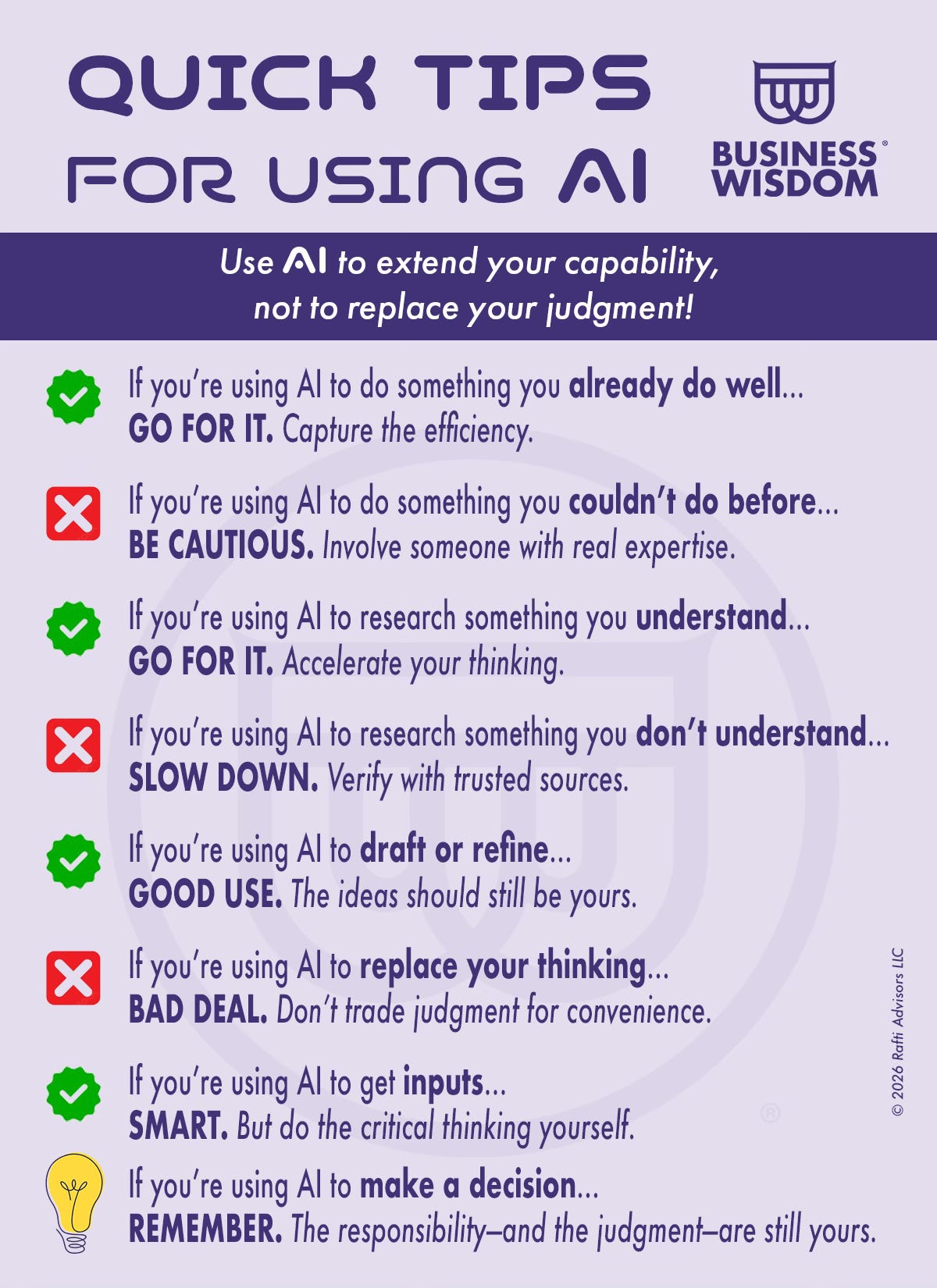
The irony is that the very tool creating this tension—AI—is also extraordinarily useful. Most of us are already integrating it into our daily work in meaningful ways. The problem isn’t the use of the tool; it’s the potential for over-reliance. When we consistently turn to AI for answers without doing the underlying thinking ourselves, we begin to lose the ability to evaluate what we’re being given. And as that ability weakens, our dependence increases.
And the dangerous part is that it is a reinforcing loop that tightens like a noose.
At some point, a question begins to surface: if I didn’t arrive at this conclusion myself, can I trust it? And not long after, a more concerning question follows: can I trust myself to know the difference?
This is where the issue becomes particularly relevant for leaders. Organizations don’t operate on information alone—they operate on decisions. And decisions are only as good as the judgment behind them. If judgment begins to erode, even slightly, the effects show up quickly: slower decision-making, increased need for validation, and an overconfidence in outputs that appear polished but haven’t been fully examined.
The risk is not simply that AI will produce incorrect answers. The deeper risk is that it diminishes our ability to recognize when it has.
The response is not to step away from AI. That would be both impractical and counterproductive. Instead, the focus has to shift back to strengthening the person using the tool. This means maintaining the discipline to think independently, to reason from first principles when necessary, and to test outputs against experience and multiple sources of truth. It requires a deliberate effort to stay engaged in the process of understanding, rather than defaulting to convenience.
Ultimately, trust in information has always been downstream of trust in judgment. Tools will continue to evolve, and the volume of information will only increase. But the responsibility for making sense of it does not go away.
When someone can no longer trust their memory, the world becomes uncertain. When someone can no longer trust their judgment, information becomes uncertain.
AI does not just change how we access answers. It quietly challenges whether we still trust ourselves to evaluate them.
And that may be the more important question to sit with.
My father’s namesake is the generation that will deal with the brunt of our adjustment as we discover how to best deal with AI and its influence on our daily lives. He gave a commencement speech at the University of Oregon this past week. It’s worth a listen.
His grandfather would be proud.