A friend from my golf foursome sent me this picture. Von works part-time as a starter at a local country club, and someone had posted a notice in the caddyshack for employees looking for more hours.
It starts innocently enough: Seeking more hours? Ask yourself these questions… Are you available? Are you engaging with members and guests? Are you dependable? Do you clean up properly at closing? Do you use downtime to take care of the details around your work area?
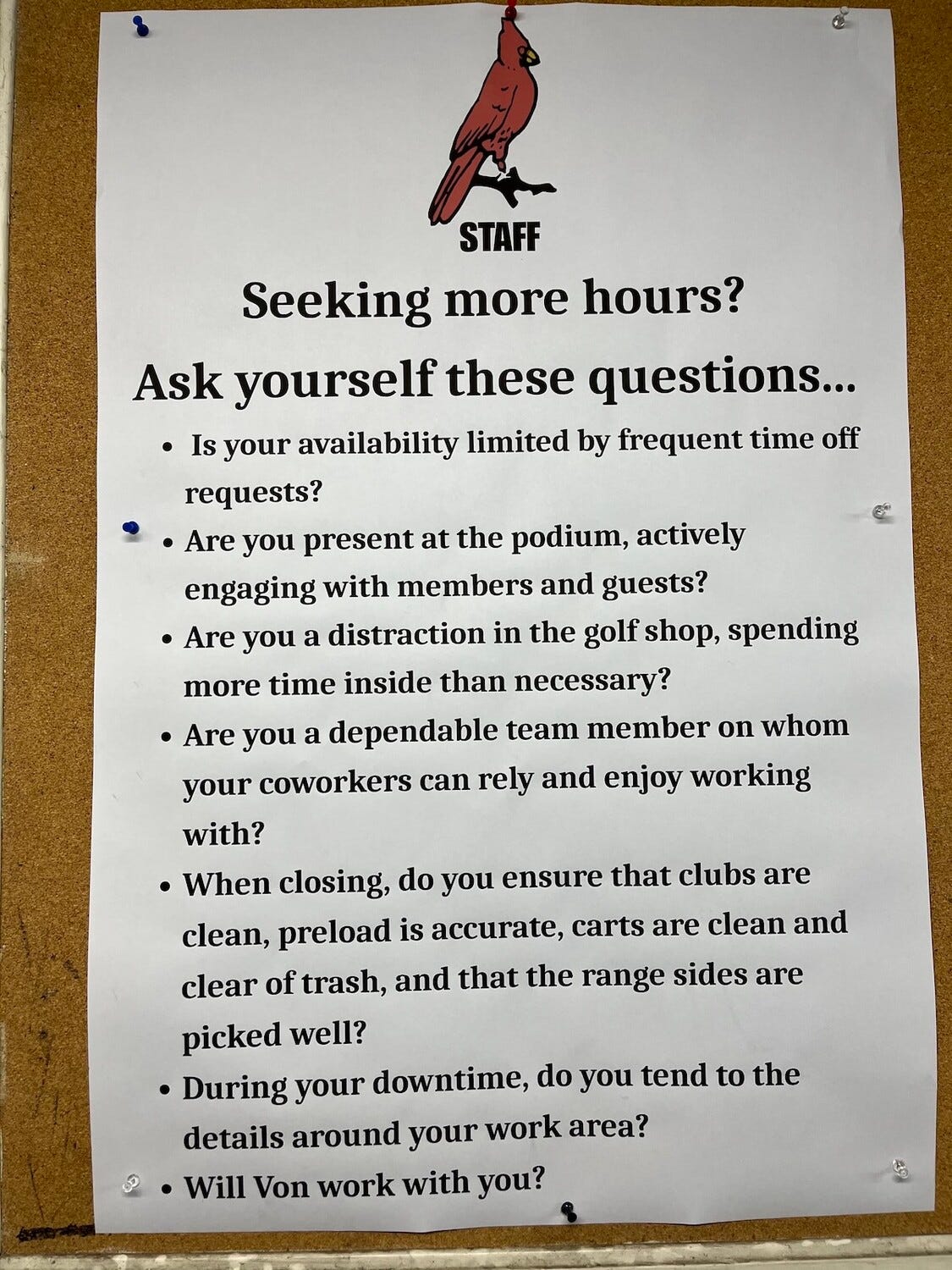
Von texted the picture because he thought I’d find it funny. I did. It is, after all, a sign posted in a golf course caddyshack, and it feels like it ought to have a punchline somewhere. As I searched for the perfect Caddyshack GIF to send back to our golf foursome text thread, though, I realized something:
This corkboard poster is pure management genius.
Most of what it says is remarkably basic. Show up. Be dependable. Engage with customers. Help your coworkers. Take care of the place. Business books have been written using considerably more words to say considerably less.
But then I got to the last question: Will Von work with you?
That might be the most important question on the page.
The Stated Standard and the Lived Standard
Every organization has at least two standards. There is the stated standard—the behaviors management says it expects. Then there is the lived standard—the behaviors people learn are actually expected, rewarded, tolerated and respected.
The bulletin board does a pretty good job articulating the stated standard. But “Will Von work with you?” is different. That’s the lived standard.
Von isn’t the manager. He’s one of what I like to call the old soldiers. Every organization has them. They’ve been around long enough to understand how the place really works. They’ve seenemployees come and go, endured busy days and difficult customers, covered for coworkers, fixed mistakes and learned which details actually matter. They’ve also developed a pretty good sense for who can be counted on.
Old soldiers accumulate something management systems struggle to replicate: pattern recognition earned through experience. They don’t need another performance review to tell them someone isn’t pulling their weight. They’ve already worked beside that person.
And eventually, the old soldiers stop complaining about poor performers. They stop coaching them. They stop trying to compensate for them. Given the choice, they simply stop working with them.
That’s why “Will Von work with you?” is such an interesting management question. It’s not really about Von. It’s an informal measure of whether someone has earned the respect of the people who know the work best.
Sam Walker found something related when researching The Captain Class. After studying some of the most dominant teams in sports history, he concluded that their extraordinary captains often didn’t resemble our conventional image of leaders. Their influence came less from charisma and speeches than from doggedness, emotional control, courage, behavior and the way they carried themselves every day.

The old soldiers in an organization can play a similar role. They may have no formal authority whatsoever, but they can have enormous influence over what behavior earns respect. Management may articulate the stated standard, but the old soldiers often help determine the lived one.
And that’s where this becomes a question of culture.
Who Really Sets the Standard?
I once wrote that culture isn’t really a root cause of business problems; it is one of their most revealing symptoms. Organizations can declare their values, put them on walls and repeat them at company meetings, but culture doesn’t automatically obey those declarations. Culture emerges from the decisions people observe every day—particularly the decisions made when values collide and something has to give.
The same thing happens with standards. Management can say, “We expect everyone to be dependable.” But what happens when someone repeatedly isn’t? Management can say, “Everyone needs to pull their weight.” But what happens when someone doesn’t? Managementcan say, “We take care of each other.” But what happens when the same people are always cleaning up everyone else’s mess?
The answers to those questions—not the words on the bulletin board—become the lived standard.
This is where the old soldiers become important. They aren’t just participants in the culture; they are remarkably sensitive instruments for detecting it. They know the difference between what management says matters and what management actually permits. They also influence everyone around them. Their approval, frustration, work habits and choices quietly teach newer employees what “good” really looks like around here.
That makes them both keepers of the lived standard and an early-warning system when the stated and lived standards begin to separate.
If your most experienced, dependable people increasingly avoid working with someone, that is organizational information. It is a canary in the coal mine.
The Cost of Tolerance
There is another side to this that managers sometimes miss. When you tolerate a poor performer, you aren’t merely making a decision about that employee. You are changing the working conditions of everyone around them.
Someone covers the shift. Someone fixes the mistake. Someone cleans what wasn’t cleaned. Someone handles the frustrated customer. Someone stays a little later because someone else didn’t finish. And who usually absorbs that work? Your good people.
That’s the cruel irony of tolerating poor performance: the better someone is at their job, the more likely they are to pay the price for someone who isn’t.
Do that long enough and you send a powerful message about the lived standard. Dependability may be written on the wall, but apparently it isn’t required. Attention to detail may be encouraged, but apparently someone else will handle the details. Teamwork may be one of the company’s values, but apparently teamwork means the dependable people compensate for the undependable ones.
Eventually, the old soldiers figure this out. They don’t need a memo. They simply begin protecting themselves from the people who make their jobs harder.
That’s why I think the manager who wrote this notice did something clever. More hours aren’t being presented as an entitlement based on wanting more hours. They’re connected to behaviors that make the entire operation work better. And then the manager added an unofficial but wonderfully revealing test:
Will Von work with you?
There’s respect embedded in that question. You don’t get to demand that kind of respect because of your title, tenure or desire for more hours. You accumulate it through hundreds of mundane interactions: showing up, doing what you said you’d do, helping when something needs doing, and taking care of details when nobody is watching.
Every manager should know who their Vons are.
More importantly, every manager needs to pay attention when a Von won’t work with someone. Because by then, the old soldiers may be telling you something about your culture that your performance management system hasn’t figured out yet.

Check out The Leadership Podcast on iTunes, Spotify and YouTube!